

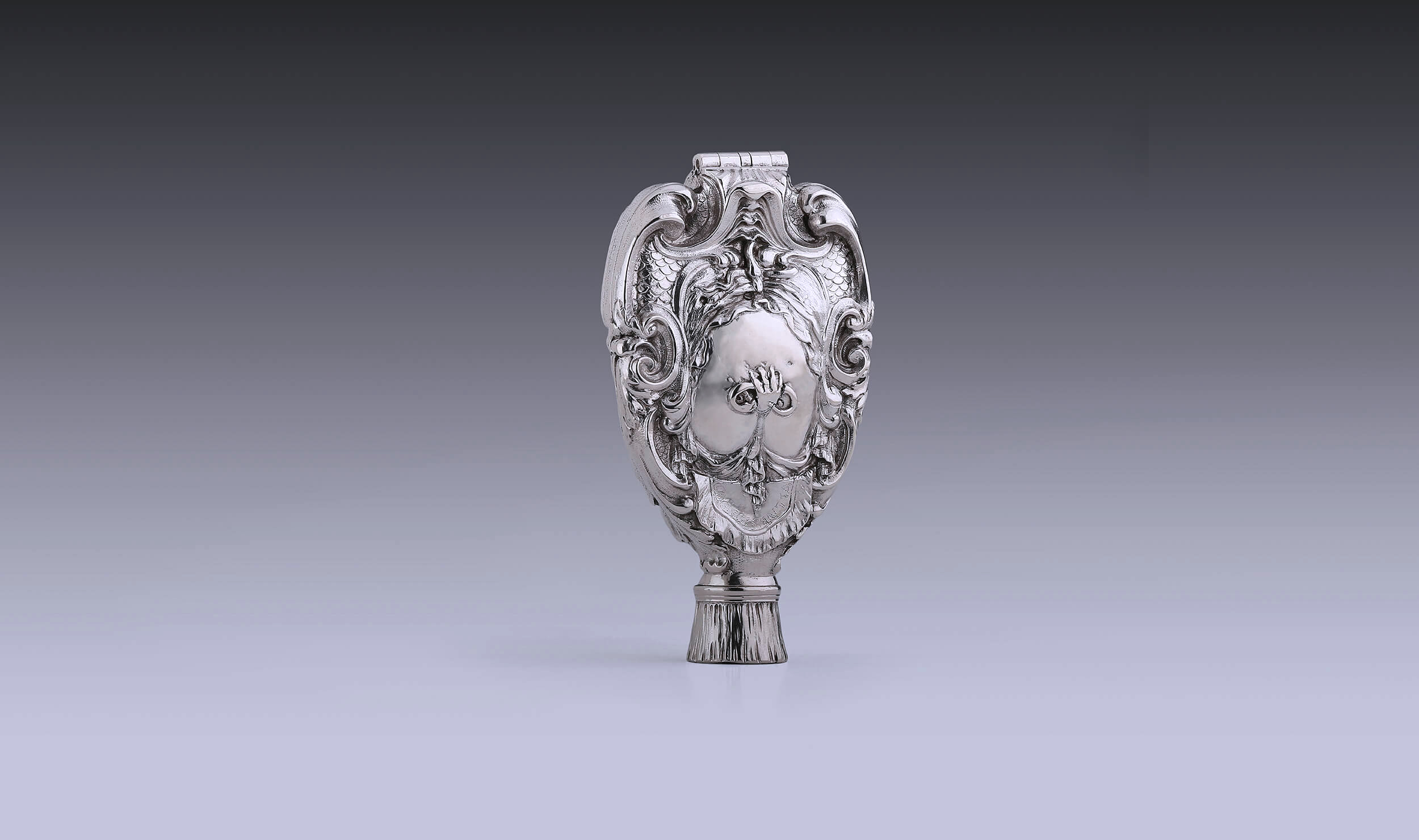
This seventeenth-century snuff grater, made entirely of silver, is notable for its strong sculptural character. It belongs to a small group of hand-held graters produced from the second half of the seventeenth century onwards for grinding tobacco into snuff at home. Most known examples are made of wood or ivory fitted with a steel grater. This appears to be the only known Dutch example executed wholly in silver. The costly choice of material emphasises the object’s function as a status symbol.
On the front, a striking head is modelled in high relief: a so-called tronie. The face, shown slightly turned to one side and defined by a pronounced nose and jawline, entirely in line with the pictorial genre that was particularly popular in seventeenth-century Northern Netherlandish painting. Tronies were used to explore character, expression and human types, based on the widespread belief that outward appearance reflected inner disposition.
An Early Snuff Grater
Tobacco
In the sixteenth and seventeenth centuries, tobacco was not only smoked or chewed, but also finely ground and snuffed. This form of use was considered invigorating and was often associated with medicinal benefits. Contemporary sources record that Louis XIV used snuff to relieve migraines. As was often the case at the French court, this habit was soon adopted by the nobility and developed into a fashionable practice.
Karotten
Before it could be grated, tobacco was first processed into so-called karotten: cylindrical rolls made from spun and plaited leaves. These were soaked in aromatic sauces, the composition of which varied from one producer to another and was carefully guarded. After fermentation, drying and maturation—a process that could take weeks or even years—the rolls were ready to be grated into snuff.
Mechanism and Interior
The refined construction of the grater is closely related to this use. The openwork, tassel-shaped finial at the base can be unscrewed, allowing the object to open. Inside is a finely worked silver grater, with a hollow space beneath it to collect the grated tobacco. In the opposite half is a hinged inner lid, its rim decorated with cast C-scrolls and fleur-de-lis. By turning the rosette at the centre, the lid is released by a steel spring mechanism, revealing a compartment intended to hold an ungrated tobacco karot.
Lupercalia
The form of the tronie can be placed within a broader European visual tradition. Although comparable tronies appear in fifteenth-century painting—notably in the work of Jheronimus Bosch, Leonardo da Vinci and Arent van Bolten— the form and expression show a clear relationship to the marotte. This was the carved fool’s head mounted on the parody sceptre of the Burgundian carnival society La Mère folle, founded in fifteenth-century Dijon. The society drew its symbolism from the Roman festival of Lupercalia, celebrated annually in February in honour of Lupercus, the god of fertility. During these festivities, social hierarchies were temporarily reversed, a principle that later survived in carnival traditions.
Sceptres
Within this tradition, the marotte functioned as a vehicle for satire and moral commentary. Examples of such sceptres are preserved in the Louvre and the Museo del Bargello, dating from the fifteenth and sixteenth centuries. A nearly identical fool’s head carved in ivory appears on a Delft violin in the collection of the Rijksmuseum. The identification of these heads as fools is indicated by bells incorporated into the cap—features that are notably absent from the silver tronie on this grater. After Louis XIII banned the society in 1636 because of disorderly and licentious behaviour, the marotte continued to survive as a visual motif, stripped of its explicit carnival context.

Van Vianen
In Dutch silverwork, tronies occur mainly in the first half of the seventeenth century, usually as ornamental elements without a direct reference to the fool. Comparable heads appear in the work of Adam van Vianen, particularly on wine ewers and drinking bowls . These figures also wear a hood-like headdress, the capuchon, which covers the head and neck while leaving the face exposed. Here too, the tronies function not as fools, but as expressive and morally charged motifs which is also the case with the tronie on this snuff grater.
Gula
This snuff grater contains further layers of meaning. On the cap of the tronie is a winged mythical creature, which may be read as an allegorical reference to Gula, the deadly sin of gluttony and excess. In early modern visual culture, such allegories served as moral warnings, placing pleasure and self-control in deliberate tension.
Cognoisantia
This moral dimension is reinforced on the reverse of the object. In the centre of the plain field, a lizard’s claw standing on a snake is depicted, framed by draped cloth and a broad lambrequin. Engraved within this lambrequin is the word Cognoisantia, meaning knowledge, insight or self-awareness. It functions as a warning against the seductive contents of the grater and may be seen as a seventeenth-century precursor to the cautionary messages found on modern tobacco packaging. The birds head above the shield, shown holding a snake in its beak, can be interpreted as a symbol of self-control and insight. In early modern visual language, the snake often represents temptation and base instinct, while the bird overcoming it embodies a moral counterforce.
The grater is exceptional, as no other example made entirely of silver is known, and for the virtuosity and expressiveness of its design; it invites comparison with works by Adam van Vianen and Johannes Lutma. As such, the grater unites refined craftsmanship, everyday practice and moral reflection in a single, compact object, in keeping with seventeenth-century cultural conventions.