
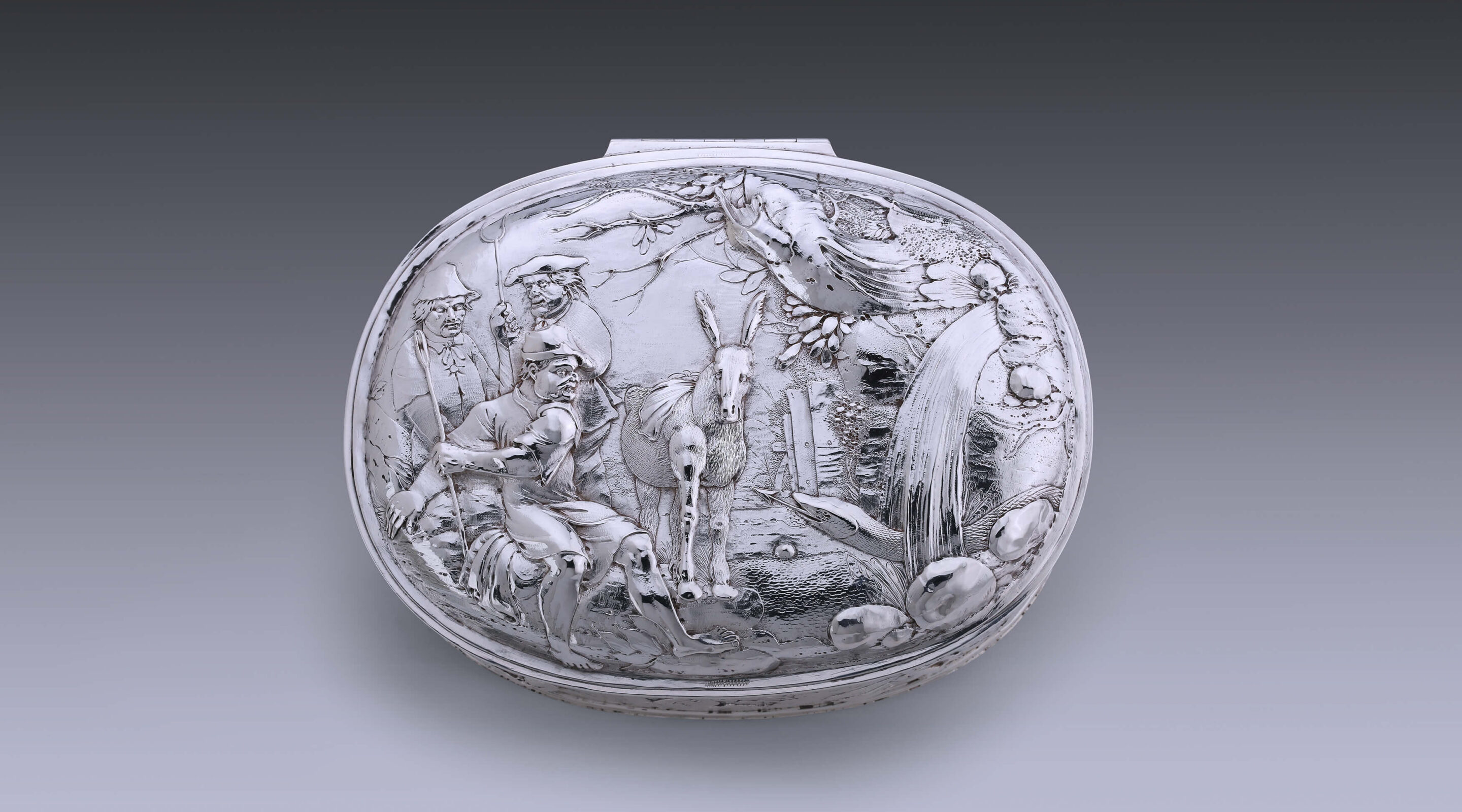
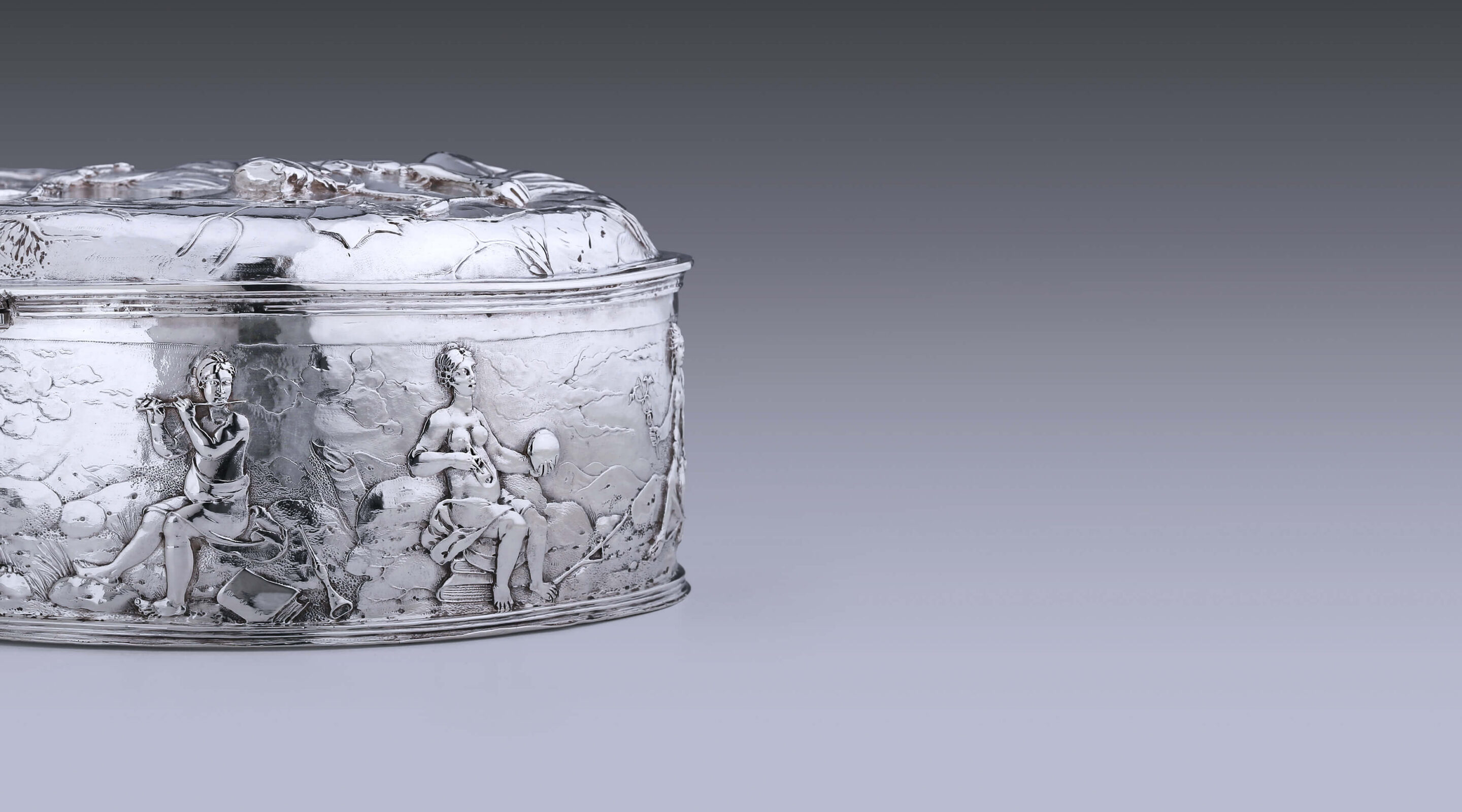
The impressive size of this large oval silver box, the refinement of the chased decoration and the iconography depicted on it, all point to a luxurious utilitarian object, intended for a wealthy patron. The box, made in 1655 in Bolsward by Claes Baardt, most likely formed part of a toilet set.
The richly and powerfully chased scene on the lid shows three shepherds in a landscape, startled by a snake beside a donkey. Through the careful construction of foreground and background and the subtle transitions between high and low relief, a strong sense of depth is achieved. The sides of the box are also entirely decorated with finely chased scenes. The quality of this chasing accords with Claes Baardt’s reputation as one of the most accomplished chasers in seventeenth-century Frisian silver.
An Impressive Frisian Box
Inspiration
The biblical and classical themes combined on this box not only demonstrate the maker’s technical mastery, but also reflect the cultural frame of reference of the elite for whom it was made. Gods and mythological figures from classical antiquity serve here as exemplars of Protestant values.
Stories from Ovid’s Metamorphoses—texts that formed part of the standard curriculum of Latin schools in the seventeenth century—were an important source of inspiration for artists and engravers such as Hendrick Goltzius and the brothers Artus Quellinius and Hubertus Quellinius. Silversmiths likewise made extensive use of print series and model books and, like painters, were guided by such examples. Claes Baardt frequently combined motifs in his repoussé silver reliefs derived from engravings after, among others, Rembrandt, Antonio Tempesta and Hubertus Quellinius.
Scene on the Lid
The scene chased in high relief on the lid can be related to Numbers 22, the Old Testament story of the prophet Balaam and his donkey. In this narrative, the donkey perceives a divine apparition that remains hidden from Balaam. After Balaam repeatedly strikes the animal, the donkey speaks to him and warns him of impending danger. In this representation, the angel mentioned in the biblical text has been replaced by a snake. This is most likely a free interpretation of the biblical story, as is frequently encountered in seventeenth-century goldsmiths’ work. The scene symbolises the importance of vigilance, humility and recognizing divine warnings—even when they come from an unexpected source.
The Sides
Around the sides of the box, the nine Muses are depicted in relief, accompanied by Pegasus, the winged horse. The Muses of Greek mythology are identifiable by their traditional attributes.
Urania, the Muse of astronomy, is shown with a globe, a pair of compasses and an armillary sphere; Polyhymnia, the Muse of mime and sacred song, is depicted holding a sceptre; Erato, the Muse of lyric poetry, holds a pair of compasses and a globe; Euterpe, the Muse of music, is shown with a transverse flute, with a lute beside her; Terpsichore, the Muse of dance, carries a lyre and a harp. Clio, the Muse of history, holds a pen and books; Melpomene, the Muse of tragedy, song and dance, holds a dagger and a sheet of paper and is seated beside several books. Thalia, the Muse of comedy and festivity, carries a fool’s staff. Calliope, the Muse of heroic epic and eloquence, is recognizable by her books and laurel wreath.
Technique
The decoration of this box was chased and chiselled from the silver. In this technique, the relief is formed from the reverse by hammering the silver sheet, followed by refinement on the front using chasing tools. This method demanded a high level of technical skill.
Baardt’s works demonstrate that he mastered these skills to an exceptional degree. They are characterised by finely executed chasing, often depicting hunting scenes or battles, as well as refined representations of figures, flowers, butterflies and insects. His chased work was widely admired, and he was a sought-after silversmith. His reputation is evident, among other things, from the commissions he received in 1682 and 1683 from Henricus Popta to make two chased candlesticks, a mustard pot and a salt cellar. Popta, an advocate at the Court of Friesland, belonged to the provincial elite and owned a substantial collection of silver, parts of which are now preserved as the Popta Treasure in the collection of the Fries Museum.
Dressing Table
This large box was very probably intended for use on a dressing table and served to hold combs or hair caps. In the collection of the Fries Museum is a small oval box by Baardt dated 1656, which he likely made as a companion piece to this larger example. The lid of this smaller box, measuring 8.8 cm in width, is also decorated with a chased scene depicting Mercury and Argus. A brush back with a chased representation of Apollo and Daphne, likewise made by Baardt, probably adorned the same dressing table. To date, these are the only known dressing-table objects from Bolsward.
Claes Fransen Baardt
Claes (1628–1693) ranks among the most important Frisian silversmiths of the seventeenth century. Of the four generations of silversmiths produced by the Baardt family, Claes Baardt was the second and the most virtuoso. He was born in Bolsward, the eldest child of the silversmith Frank Rienks Baardt and Lyuwkien Clases Allinga. Claes likewise became a silversmith and entered apprenticeship with his father. On 1 December 1640 he was registered as an apprentice in the gold- and silversmiths’ book of Bolsward, at the age of twelve. On 3 May 1654 he was admitted as a master in the guild, having successfully completed the master’s examination. It is highly likely that he took over his father’s silversmith’s workshop.
Claes Fransen Baardt was not solely engaged in the silversmith’s trade. In addition to working as a smith, he invested in real estate. The Bolsward orphanage records further show that, like his father, Baardt also traded in cloth and textiles and managed business affairs on behalf of his mother-in-law. In the year he became a master, he married Siucke Harckes, daughter of the cloth merchant Harcke Gerrits and Trincke Rinnerts, a favourable match. Through Rinnert, Siucke’s brother, Baardt became connected to the renowned silversmith family Van der Lely in Leeuwarden. After Rinnert’s death, his widow Ijnske Nannes Okma married Frederick Jarichs van der Lely.
Two Maker's Marks
Claes Baardt is currently believed to have used two maker’s marks. The first is a star-shaped mark, used between 1654 and 1661. Thereafter, from 1663 as far as is known, he employed the family coat-of-arms mark featuring a sickle and three stars. At some point he thus changed his maker’s mark, replacing the star with the family arms. The death of his father around this time may have played a role, as it made Claes Baardt the pater familias of this branch of the family.
Marked on the underside with the town mark of Bolsward, the date letter D for 1655, and the star-shaped maker’s mark of Claes Fransen Baardt.