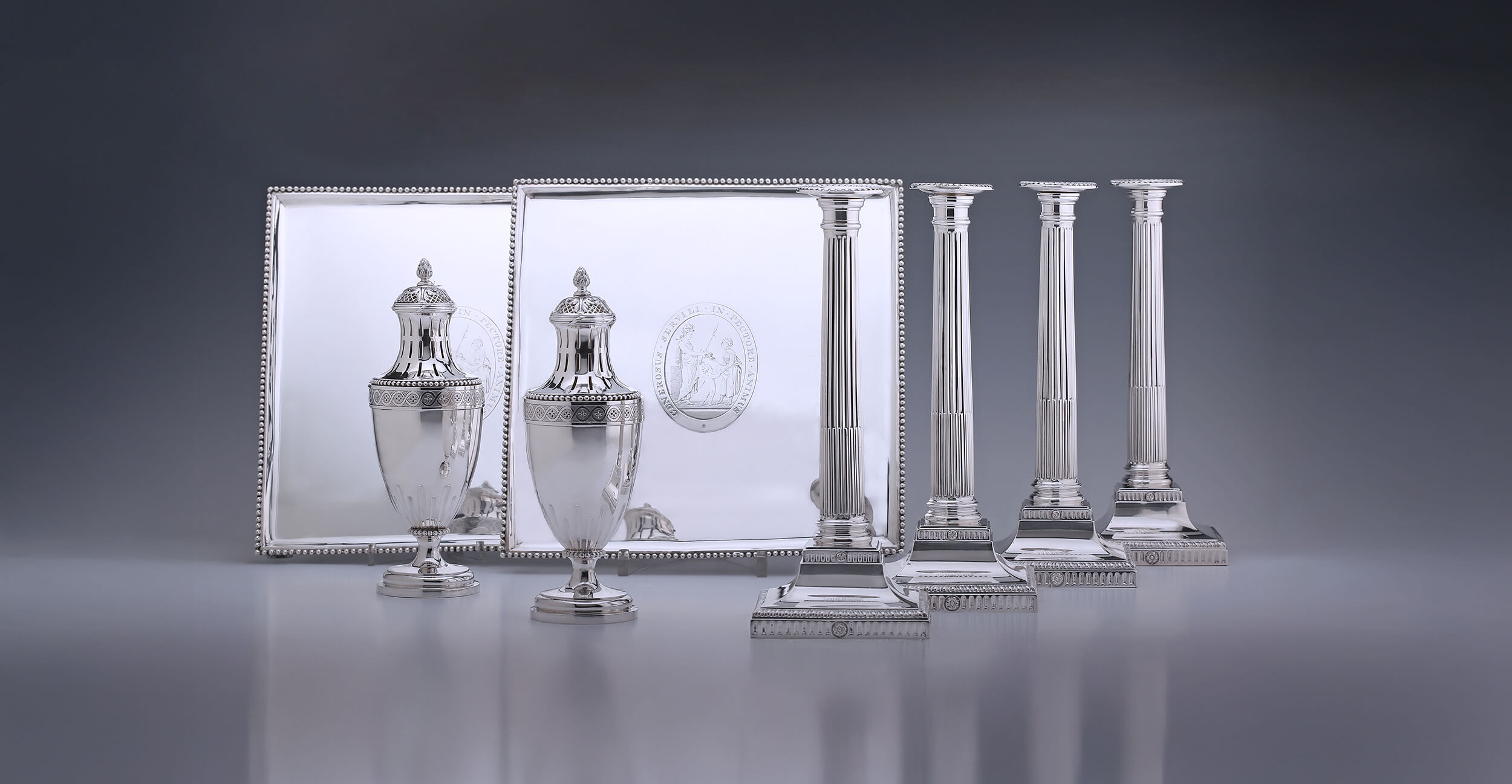
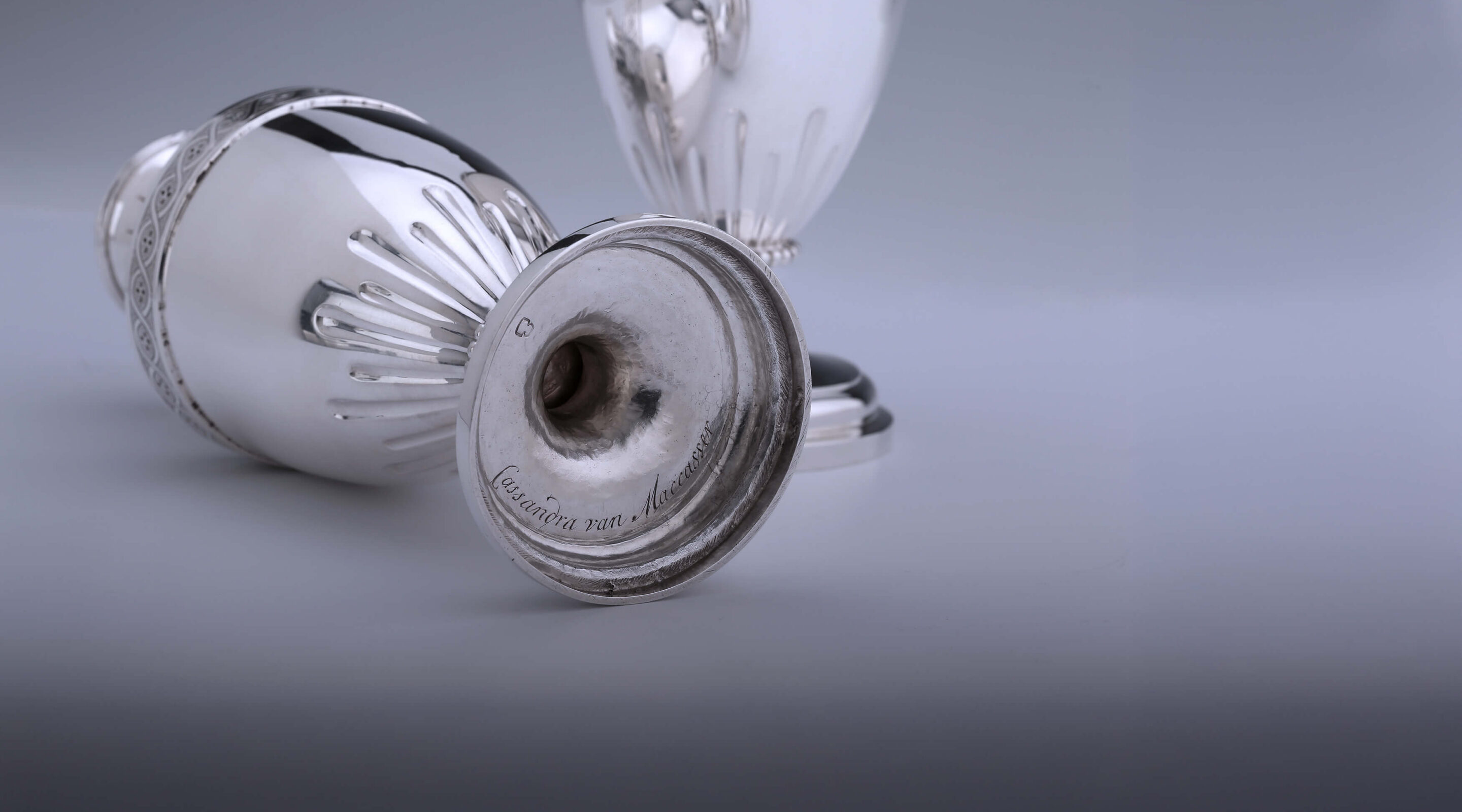
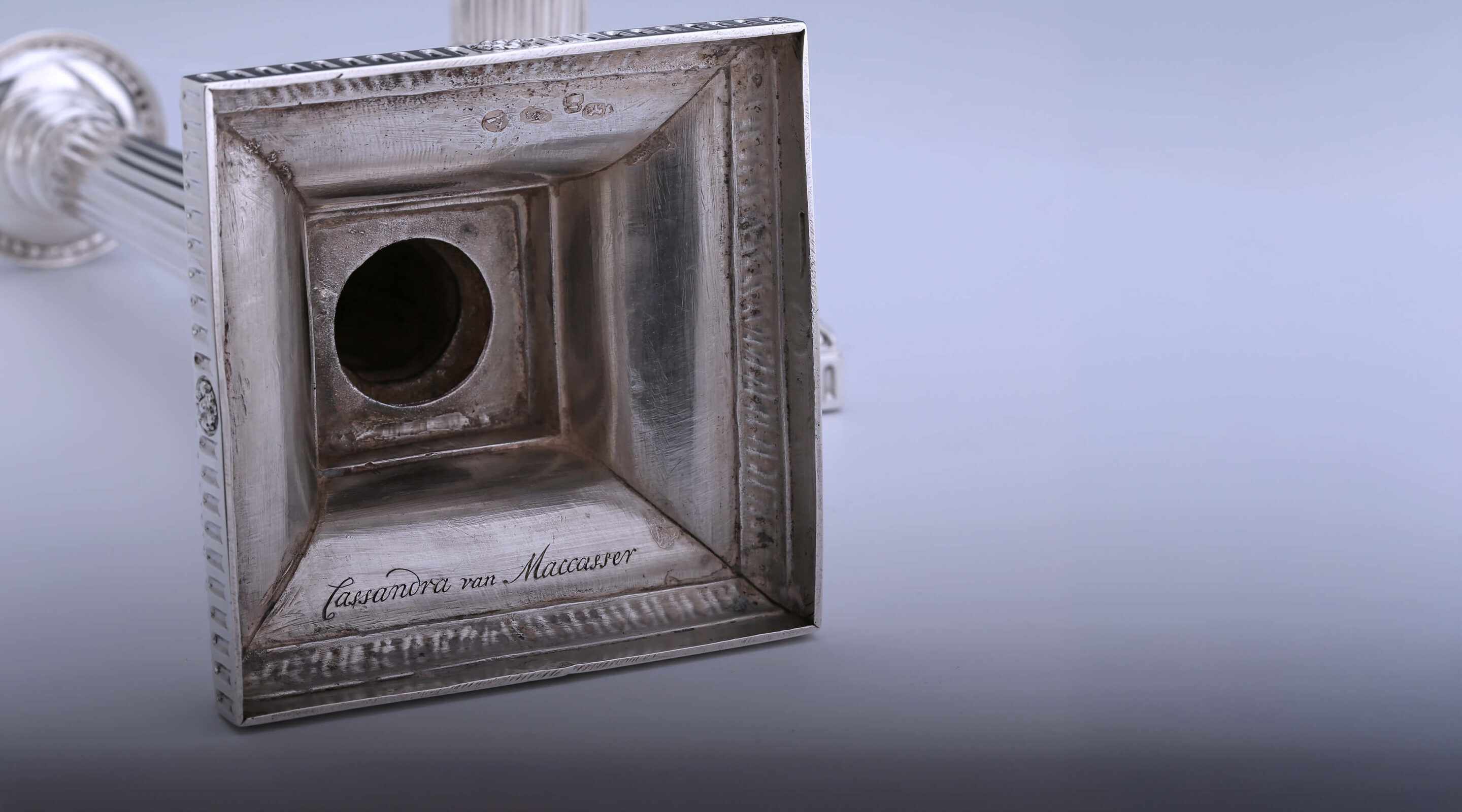
This exceptional eight-piece silver ensemble from 1780 brings to light a previously unknown story of slavery and manumission in Dutch colonial history. The set was made in Amsterdam on the commission of Balthasar Daniel van Idsinga, using money he inherited from Cassandra van Macasser, an enslaved woman whose freedom had been bought by his parents and who had raised him in Batavia as his baboe (nursemaid). Van Idsinga had her name and her bequest engraved in the silver. The fact that the complete set has remained together after 246 years, and comes directly from the commissioning family, makes the discovery all the more remarkable.
The Engraving
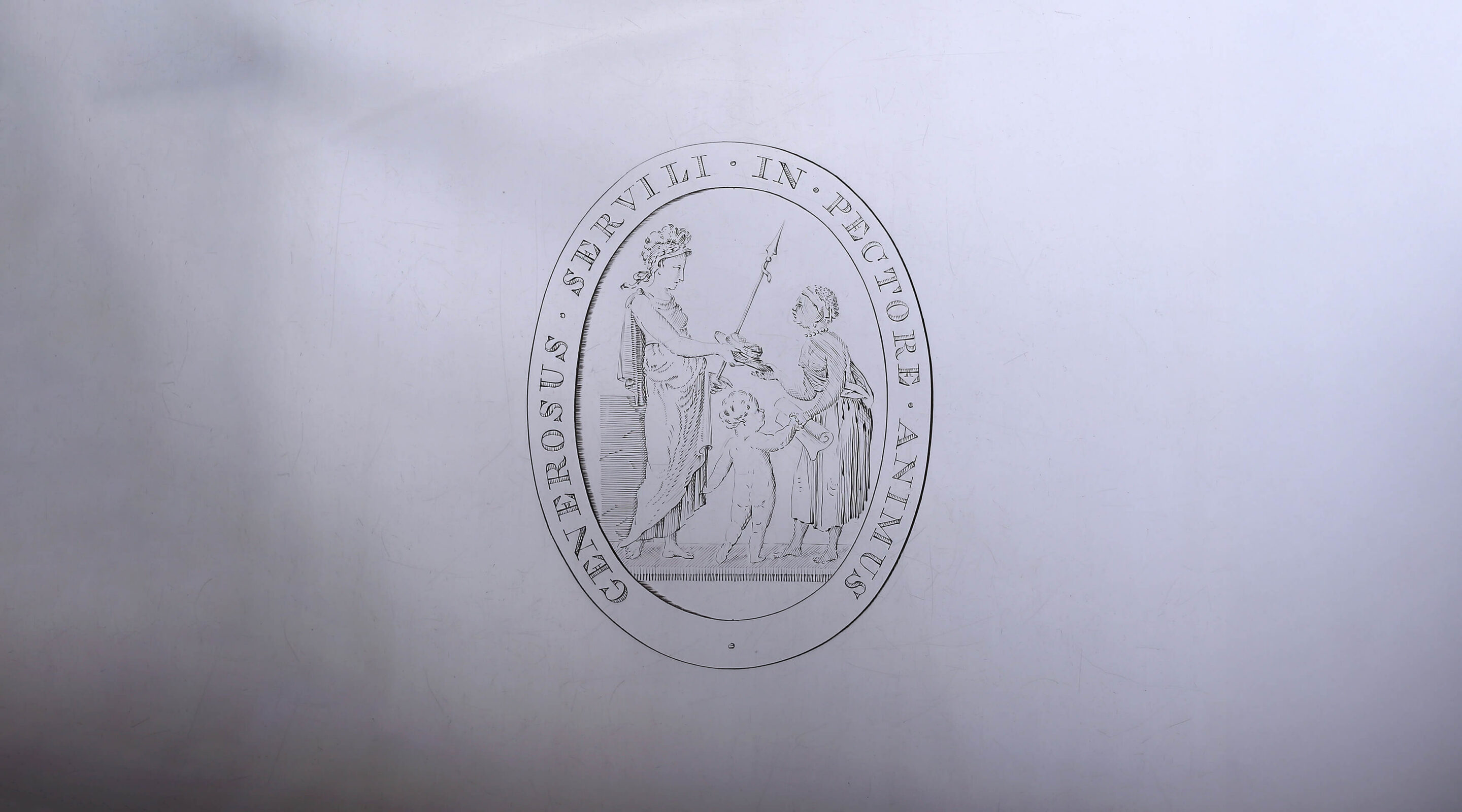
An image is engraved on the front of the salvers: within an oval stands Minerva, who is handing over a liberty cap, while beside her a putto gives a document to an African woman. Around it runs the text: Generosus servili in pectore animus, "a noble spirit in a servile breast."
This anti-slavery emblem conveys the message that even an enslaved person possesses a noble spirit. Minerva, the symbol of wisdom and virtue, takes on the role of protector of human dignity and breaker of chains. The liberty cap she bestows derives from the Phrygian cap, which in the Roman Empire was already the symbol worn by a freed slave as a sign of his freedom.¹ In this engraved scene, Minerva grants the African woman freedom as a form of recognition, with the putto symbolising future, liberated generations.
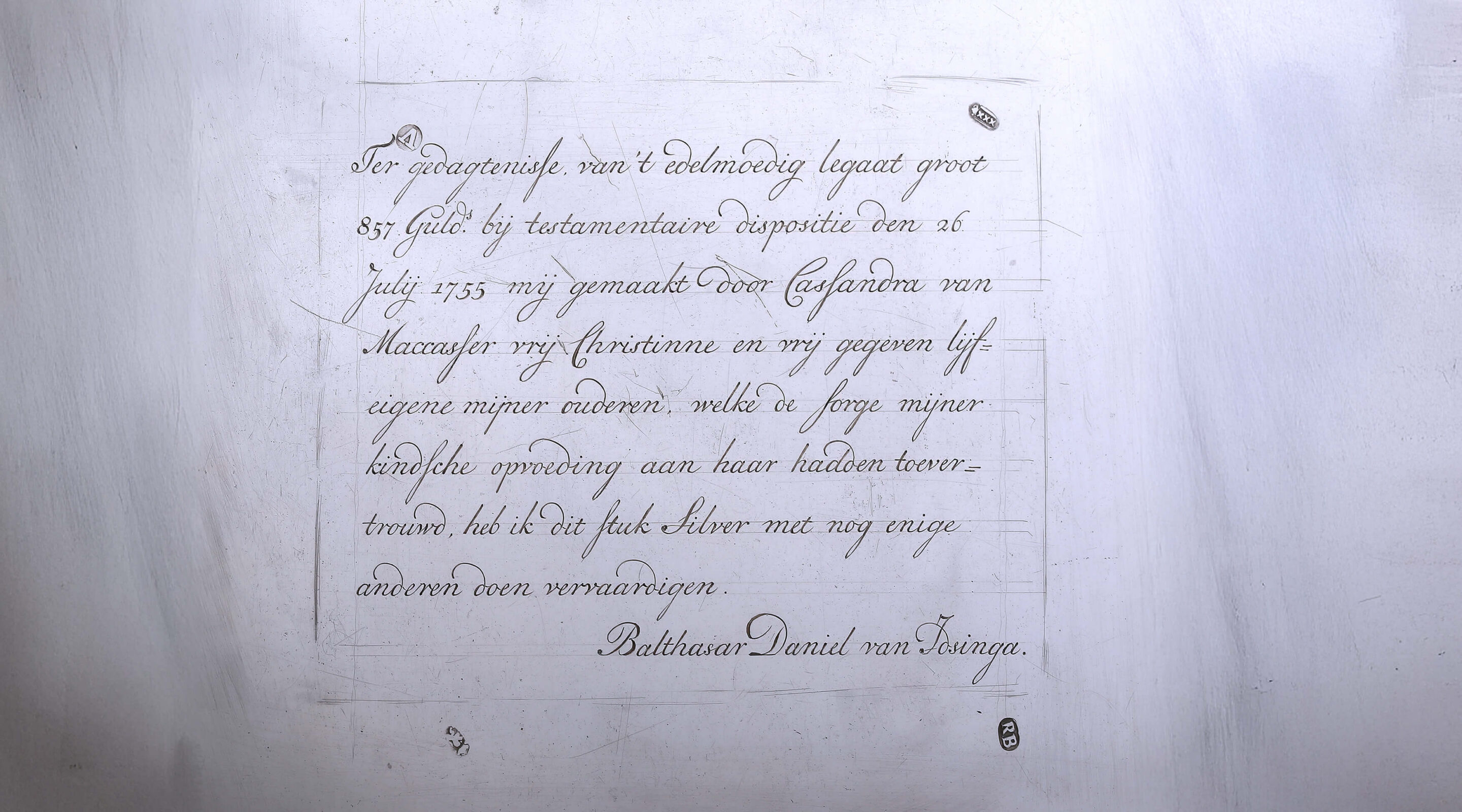
On the back of the salvers a text is engraved:
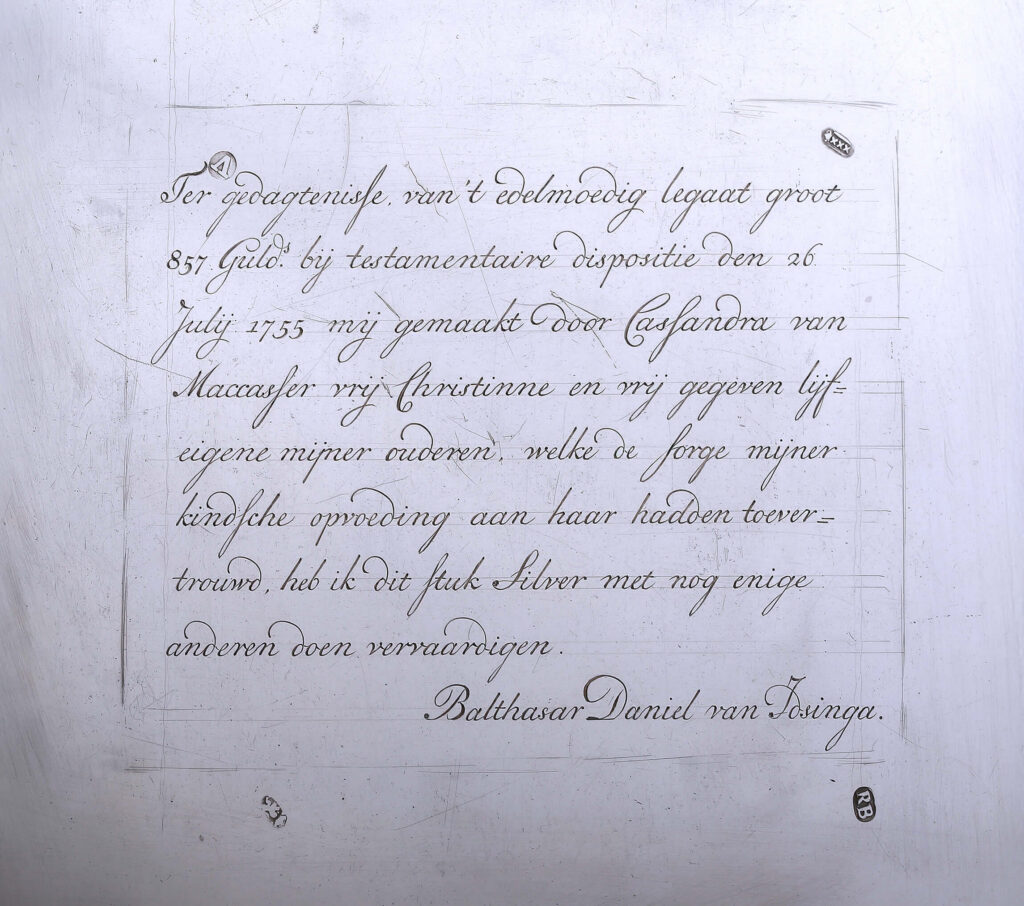
Which translates in: In memory of the generous bequest, amounting to 857 guilders, made to me by testamentary disposition on 26 July 1755 by Cassandra van Maccasser, a free Christian woman and manumitted bondswoman of my parents, who had entrusted the care of my childhood upbringing to her, I have had this piece of silver made, together with several others.
— Balthasar Daniel van Idsinga
The silver is therefore not a family heirloom in the usual sense. It is an expression of gratitude from Balthasar Daniel van Idsinga to Cassandra: a woman who was no blood relation, but his baboe, the person to whom his parents had entrusted his upbringing, and who left him her possessions after her death.
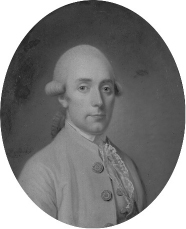
Balthasar Daniel van Idsinga (1781) by Benjamin Bolomey
Slavery and Manumission in Batavia
In the middle of the eighteenth century, Batavia was a city in which enslaved people made up between twenty-five and sixty per cent of the population. Unlike plantation slavery in the Atlantic world, this was chiefly domestic slavery, combined with work as craftsmen and on ships. The city had a permanent slave market, and conditions were harsh: strict control, severe punishment, and a constant fear of rebellion on the part of the VOC.
Enslaved people who were sold were given a new, European name, taken from the Bible or classical antiquity, and sometimes even from the months of the year. A toponym was often added to this, indicating where the enslaved person came from or where he or she had been traded.²
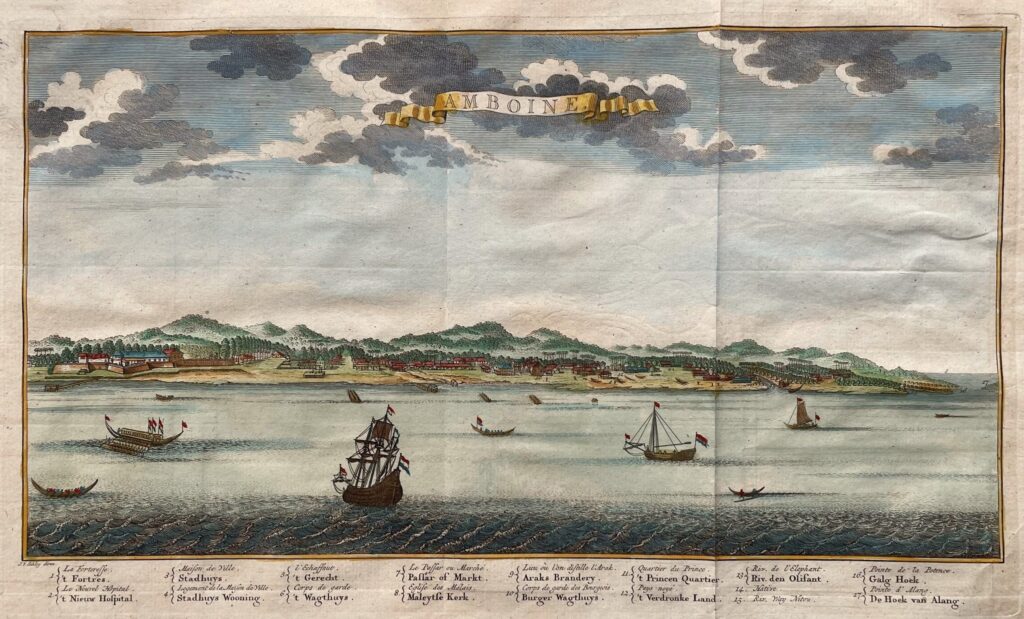
In this case, the name came from Greek mythology: Cassandra, a Trojan princess, with the toponym van Macassar, derived from Makassar on the island of Celebes, present-day Sulawesi. Cassandra was the bondswoman of the parents of Balthasar: Meyert Johan van Idsinga, commander of Sumatra's West Coast and, from 1756, governor of Amboina, and his wife. As was customary in colonial households, she was subsequently entrusted with the care of a child of the family, in this case Balthasar Daniel, born in 1745. It was generally not the European mothers but the baboes who passed on daily upbringing, language and culture to the children. At some point she was bought out of slavery by the family.
The Will
At that time, Cassandra was a free, baptised Christian woman. On 26 July 1755 she had a will drawn up. Her principal heir was Adriana van Batavia, about whom nothing further is known. Should she die without legitimate descendants, the inheritance would pass to the son of her former owners: Balthasar Daniel van Idsinga. In the end, Cassandra left him the sum of 390 "rijkdaalders".
After his return to the Republic, Balthasar Daniel van Idsinga built a career as a jurist and administrator in Groningen, where he eventually became mayor. His parents, Meyert Johan van Idsinga and Balthasarina Kien, had died in Amboina in 1763 and were interred there together.
Balthasar himself grew up between two worlds: born in Batavia, raised by a Malay-speaking baboe, and later active in the government of a Dutch city. His decision to record Cassandra's bequest in a silver ensemble, with her name and the circumstances of her manumission engraved in it, was not an obligation. It was a choice, a tribute to the woman with whom he most likely had formed a warm, maternal bond.
Remarkably Early and Explicit
This ensemble is rare for a number of reasons. It contains a very early and explicit example of abolitionist imagery, decades before the abolition of slavery in 1863. It also documents, by name and date, the life of an individual enslaved woman, information that is generally absent from colonial archives. In addition, it is one of the few objects from this period in which the relationship between a formerly enslaved woman and the family who bought her freedom is recorded directly, in the commissioner's own words.
About the Silversmiths
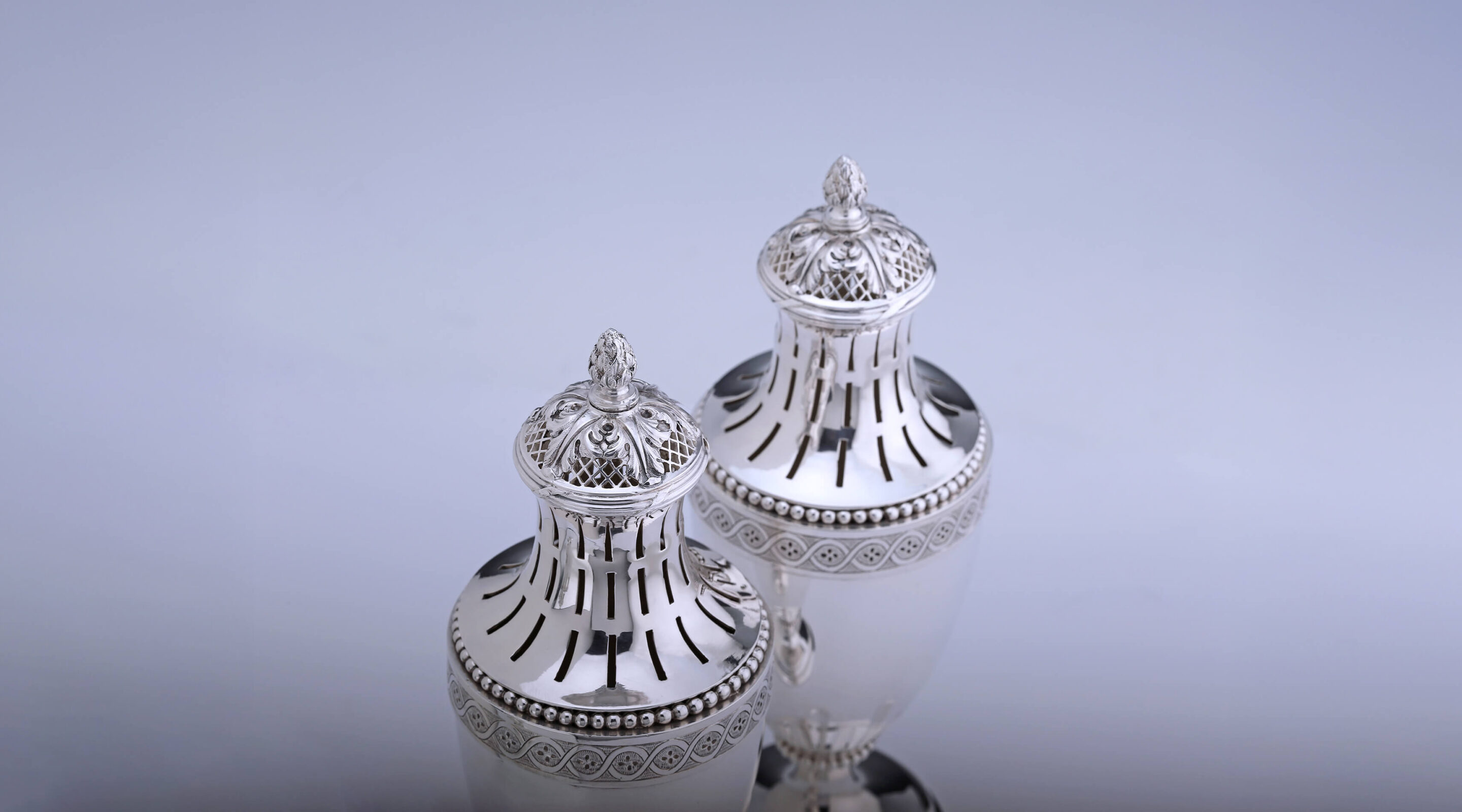
The eight-piece silver set was made in 1780 by two renowned Amsterdam silversmiths. The pair of casters and the series of four candlesticks were made by Dirk Evert Grave, and the pair of salvers, in the same year, by Reynier Brandt. The ensemble was ordered as a single whole by Balthasar van Idsinga.
Dirk Evert Grave was born the son of the clog maker Jan Evert Grave and his wife, Anna Maria Vorkenbrink. He was baptised on 13 February 1735. In 1763 Dirk Grave was registered as a citizen (poorter) of the city of Amsterdam, and by 1765 he was a master silversmith. Grave married Gezina Mey in 1775. The couple had a daughter, Hanna Elisabeth, who married the silversmith Nathanael Teuter in 1806. Grave died in 1795 at his house in the Kalverstraat, between the Gaaper- and Duyfjes-steeg, which he had bought in 1782. He must have been active as a kashouder from 1789, and the business certainly had a workshop attached to it. After his death, the workshop of this prolific silversmith was continued by his widow and subsequently by his son-in-law, Nathanael Teuter.
Reynier Brandt is one of the best-known and most prolific Amsterdam silversmiths. He was born in Wesel around 1707. In 1734 he was entered in the Amsterdam register of citizens, and in that same year he was admitted to the city's guild as a goldsmith. In 1737 he also married, in Amsterdam, Maria van Wierop, the widow of another Amsterdam silversmith (Hendrik Swierinck). Reynier died in Amsterdam in 1788. Various pieces by his hand are held in museum and private collections around the world.
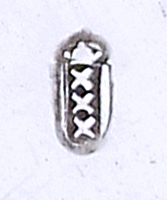
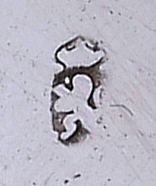
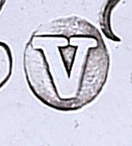
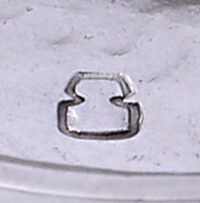
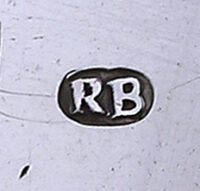
All the parts are marked on the underside with the Amsterdam city mark, the Dutch lion, the date letter V for 1780 and the maker's mark an anvil for Dirk Evert Grave; the salvers bear the maker's mark RB for Reynier Brandt.