This carved hardstone bonsai tree is a refined Art Deco masterwork. Ernst Paltscho designed the tree in gold with finely carved nephrite leafs in a red enamelled pot with a diamond-set rim. A version of this bonsai-tree brooch, also made in the 1920's, is held in the collection of the British Museum (as part of the Hull Grundy bequest).
Ernst Paltscho, Austrian Court Jeweller since 1889, became known as “Jeweller to the Kings,” servicing royalty and aristocracy. His jewellery flourished during the Art Nouveau and Art Deco eras, celebrated for its exceptional craftsmanship using diamonds, precious stones, and especially hardstone carvings. Paltscho’s inspirations were drawn from nature: flowers, fauna, and especially that iconic bonsai motif.
Under his son Erwin, this Viennese house continued into mid-century, gaining renown for carved gem and rock crystal flower brooches exhibited across Europe and New York. Today, Paltscho’s naturalistic hardstone jewels — anchored by the bonsai masterpieces — remain highly prized by collectors.
Bonsai
The art of bonsai is an ancient form of aesthetic expression that originated in imperial China, where miniature landscapes were created more than 2,000 years ago. These were often used by Taoists for meditation and contemplation. The greater the contrast between the real landscape and its miniature version, the stronger its spiritual effect was believed to be. In the 13th century, this tradition was adopted by Japan and further developed into the bonsai art as we know it today – the cultivation of a single, perfectly shaped tree in a pot (bon-sai literally means “planted in a pot”).
Nephrite
Jade is a collective term for two minerals: jadeite and nephrite. Jadeite, originating from Burma, is the rarer and more valuable variety, while nephrite, quarried for centuries in western China, is the older of the two. Only jadeite jade and nephrite jade are considered true jade. Today, most of the world’s nephrite comes from British Columbia, Taiwan, and the United States. The nephrite used in this brooch is of a fine deep-green colour and beautifully carved.
Art Deco
In the first quarter of the twentieth century, the Art Deco style flourished—a movement that combined modernity, colour, and exotic inspiration. Designers looked to distant cultures and incorporated materials such as onyx, coral, jade, lapis lazuli, and nephrite into their creations. The taste for the exotic and fascination with the East were not new phenomena, but the growing number of publications on the subject provided artists with a deeper understanding of foreign art and design. Renewed interest in Japanese art offered European designers a fresh source of stylistic inspiration. This brooch, with its stylised bonsai motif and contrasting materials, is a beautiful example of this refined aesthetic.
Ernst Paltscho
Ernst Paltscho (1858–1929) joined his father Carl’s jewellery firm in Vienna in 1881. He became court jeweller to the Greek royal family and created jewels for much of the Austro-Hungarian aristocracy. In 1914 he moved, together with Emil Biedermann, to Vienna’s first district under the name Biedermann & Paltscho. His son Erwin later continued the business and gained international recognition at exhibitions, notably in London (1934) and at the New York World’s Fair (1964), where he became known for jewels distinguished by colourful, finely cut gemstones and exceptional craftsmanship.
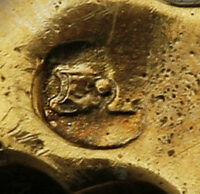
Stamped with the Austrian assay mark for 18-carat gold and a partially struck maker’s mark E.P. for Ernst Paltscho.